

Bundle pricing is a strategy where two or more products or services are sold together at a single combined price — typically lower than the cost of buying each item separately. It’s one of the most effective ways to increase average order value, move slow inventory, and improve the overall customer experience.
Definition:
Bundle pricing (also called product bundle pricing or bundled pricing) is a marketing and pricing strategy where multiple products or services are grouped and sold as a single package at a discounted or combined rate. The bundle price is usually less than the sum of individual item prices, creating perceived value for the buyer.
What is bundle pricing in marketing?
In marketing, bundle pricing serves a dual purpose: it makes customers feel they are getting more for their money, while helping businesses sell more units per transaction.
Rather than advertising each product individually, marketers create “bundle deals” that feel like an irresistible offer — which directly increases conversion rates and revenue per customer.
Bundle pricing in marketing is also used to introduce new or lesser-known products by pairing them with bestsellers.
A customer who buys a popular item might discover — and grow to love — a secondary product they wouldn’t have tried otherwise.
What type of pricing is bundle pricing?
Bundle pricing falls under the broader umbrella of psychological pricing strategies. It plays on the customer’s perception of value.
Alongside strategies like tiered pricing, volume discounts, and promotional pricing, bundle pricing focuses on increasing the perceived worth of a purchase.
Unlike a simple discount on one item, bundle pricing delivers savings across a combination of items, which feels more rewarding to shoppers.
Types of product bundle pricing
There are several distinct approaches to bundling — each suited to different business models and goals.
Pure bundle pricing (All or nothing)
Products are only available as a bundle — customers cannot purchase items individually. Common in software suites and telecom packages.
Example 1: Microsoft 365 – Word, Excel, PowerPoint & Teams — only sold as a suite, not individually.
Example 2: Cable TV packages – Basic, Standard & Premium channels — you pick a tier, not individual channels.
Example 3: Smartphone box – Phone + charger + earphones in the box — no option to skip the accessories.
Mixed bundle pricing (Most popular)
Items are sold both individually and as part of a bundle. The bundle price offers a discount, giving customers a reason to buy more at once.
Example 1: McDonald’s value meal – Burger $4 + Fries $2 + Drink $2 = $8, but the meal combo is $6.50.
Example 2: Skincare set – Each product sold solo, but a “complete routine kit” saves you 25%.
Example 3: Adobe Creative Cloud – Buy Photoshop alone or get the full app bundle at a lower per-app cost.
Add-on bundle pricing (Upsell focused)
A core product is paired with optional accessories or extras. Think: a laptop sold with a case and mouse at a reduced combined price.
Example 1: Laptop + accessories – Buy a laptop, get a laptop bag and wireless mouse bundled in at a reduced total.
Example 2: Gaming console – Console + extra controller + game bundled as a “starter pack” at launch.
Example 3: Camera kit – Camera body + memory card + lens cap + carry case sold as a beginner kit.
Cross-sell bundle pricing (Discovery driven)
Complementary products from different categories are grouped together. A classic example: a camera, memory card, and camera bag sold as a starter kit.
Example 1: Shampoo + conditioner – Two different product lines bundled as a hair care duo.
Example 2: Running shoes + socks – Sports brands pair shoes with branded socks as a “performance pack.”
Example 3: Coffee machine + beans – Appliance store bundles a coffee maker with a bag of premium coffee.
Build-your-own bundle pricing (Customer choice)
Customers select their own combination of products from a defined set, and a discount activates automatically when they meet the bundle criteria.
Example 1: Pick-3 meal plan – Choose any 3 meals from a menu and get 15% off the total.
Example 2: Supplement store – “Pick any 4 proteins, save 20%” — customer curates their own stack.
Example 3: Book subscription – Choose 3 titles from a curated list each month at a flat bundle price.
Tiered bundle pricing (More = more savings)
Different bundle tiers offer increasing value as customers buy more. The more items in the bundle, the higher the discount — rewarding bigger purchases.
Example 1: SaaS plans – Starter (3 features), Pro (7 features), Enterprise (all features) — each tier bundles more for less per unit.
Example 2: Stationery sets- Buy 5 items = 10% off. Buy 10 items = 20% off. Buy 15+ = 30% off.
Example 3: E-learning bundlesSingle course $29, 3-course bundle $69, full library $149 — clear value steps.
What is the major advantage of product bundle pricing?
The biggest advantage of bundle pricing is that it simultaneously benefits both the seller and the buyer — creating a win-win scenario that drives loyalty and long-term value.
- Increases average order value (AOV) Customers spend more per transaction without feeling “upsold” — they feel they’re getting a deal.
- Clears slow-moving inventory Pairing a less popular product with a bestseller helps move stock that would otherwise sit unsold.
- Reduces purchase hesitation When a full solution is packaged together, customers make faster decisions — fewer tabs to compare, less friction at checkout.
- Improves product discovery Customers try products they may never have purchased alone, increasing the breadth of their engagement with your brand.
- Strengthens customer retention Customers who purchase bundles tend to have a deeper relationship with a brand, leading to higher lifetime value.
Bundle pricing vs promotional pricing — what’s the difference?
A common question: what is the difference between promotional pricing and bundle pricing?
Promotional pricing
A temporary discount on a single product — such as a flash sale, seasonal offer, or coupon code. The product’s price is reduced for a limited period.
Bundle pricing
Multiple products are permanently or semi-permanently grouped at a combined price. The “discount” comes from buying together, not from a reduced individual price.
In short: promotional pricing is time-sensitive and product-specific. Bundle pricing is structure-based — the value proposition is in the combination, not the clock.
WooCommerce bundle pricing
If you run a WooCommerce store, bundle pricing is one of the most powerful strategies you can implement to grow revenue without increasing ad spend.
WooCommerce supports product bundling natively through extensions and plugins, allowing store owners to group products, set bundle-specific prices, and control inventory at both the bundle and product level.
With WooCommerce bundle pricing, you can create fixed-price bundles, percentage discount bundles, or “build your own bundle” configurations where customers select from a defined set of products and receive an automatic discount at checkout.
Whether you’re running an online clothing store, a health supplements shop, or a digital products marketplace, WooCommerce bundle pricing gives you fine-grained control over how your products are packaged and priced.
Set up WooCommerce bundle pricing with Disco (Recommended plugin)
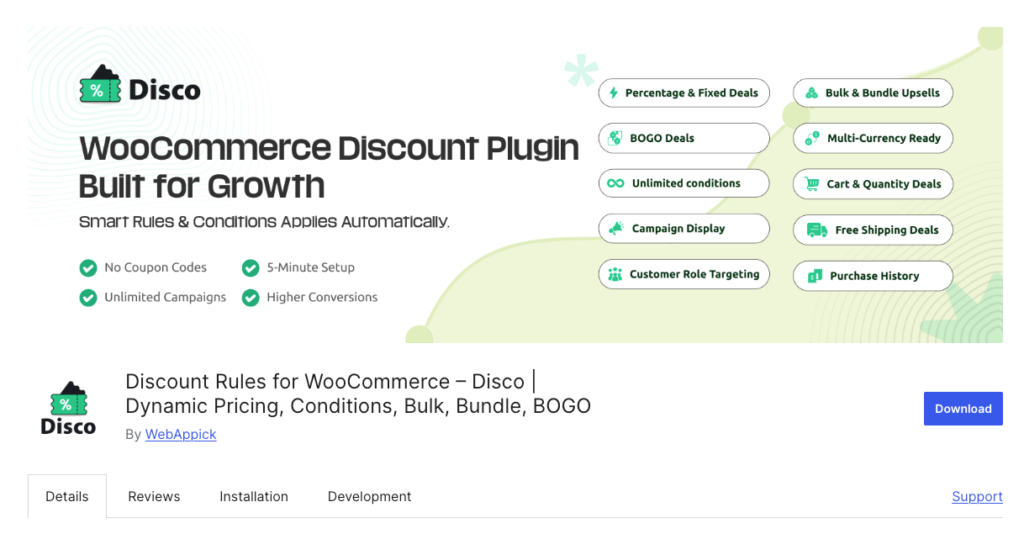
Disco is a dynamic discount and pricing plugin for WooCommerce that goes far beyond basic bundle pricing. With Disco, you can combine bundle pricing rules with a full suite of dynamic discount strategies — all from a single, intuitive dashboard.
No need to manage multiple plugins or wrestle with complex configurations.
Here’s what makes Disco stand out for WooCommerce bundle pricing:
- Bundle pricing rules
- Buy X get Y discounts
- Volume / quantity discounts
- Cart-based discounts
- Category-level pricing
- User role pricing
- Percentage & fixed discounts
- Conditional discount rules
- Scheduled promotions
With Disco, you can set up a bundle discount that says “buy this product set and save 20%” while simultaneously running a volume discount (“buy 5+ units and get 15% off”) and a loyalty rule for specific customer groups — all active at the same time.
Disco intelligently combines or prioritizes discount rules so your pricing stays consistent and profitable.
For WooCommerce store owners who want a flexible, all-in-one pricing solution, Disco eliminates the need for separate plugins for bundles, coupons, and promotional pricing — making it the smartest way to implement a full bundle pricing strategy on your store.
Frequently asked questions about bundle pricing
What is meant by bundle pricing?
Bundle pricing means selling two or more products together as a package at a single combined price, usually offering better value than purchasing each item on its own.
What is the purpose of product bundle pricing?
The purpose of product bundle pricing is to increase sales volume, improve average order value, reduce inventory of slow-moving items, and deliver more perceived value to customers — ultimately growing revenue without requiring more customers.
What is bundling pricing strategy?
A bundling pricing strategy is a deliberate approach to packaging multiple products or services at a combined price point. Businesses use it to guide customer behavior, simplify purchasing decisions, and maximize revenue per transaction.
Why would bundle pricing be used?
Bundle pricing is used when a business wants to increase the average spend per customer, create a more compelling offer than competitors, introduce new products, or reduce excess inventory — all while maintaining healthy profit margins.
Summary
Bundle pricing is a strategy where multiple products are sold together as a single package — usually at a lower price than buying each item separately. Used across e-commerce, SaaS, food, and retail, it’s one of the most proven ways to increase average order value, move more inventory, and deliver better value to customers.
In this guide, you’ll learn exactly what bundle pricing means, the 6 types of product bundle pricing with real-world examples, and how to set up bundle pricing in WooCommerce using Disco’s dynamic discount rules.