 Shanjida Haider
Tiered discount means the more you buy, the greater the reward you’ll receive.
For example – “Get 5 % off when you buy 5 units, 10% off when you buy 10 units.”
Conversely, Volume discount refers to a pricing strategy where a single reduced price is applied to all units. For example-
“If you buy 5 units, you’ll get 5% off the entire purchase; if you buy 10 units, you’ll get 10% off the entire purchase.”
Shall we drill down into the mechanism?
Tiered pricing vs Volume pricing ( Oversimplified). Right here, you’ll be taken out of this cloud of confusion.
Table of Contents
What is Tiered Pricing?
In tiered pricing, customers get rewarded progressively. Each tier carries a distinct price.
It’s like playing a video game. The higher the tier, the more privilege one gets.
For example –
| Units | Price | Level |
| 1-10 | $10 each | Basic |
| 11-20 | $9 each | High-tier -1 |
| 21+ | $8 each | High-tier-2 |
If a buyer purchases 25 units, then
- 10 × $10 = $100
- 10 × $9 = $90
- 5 × $8 = $40
Total = $230
Here, the customer gets a fair portion of the discount for each segment.
Tiered pricing = Pay Per Quantity tier
Best for: Businesses that want to create a slow-burning effect. In other words, gradually increasing rewards in quantity, such as SaaS, subscription plans, or a tier-based loyalty system.
What is volume pricing?
In volume pricing (also known as bulk pricing), buyers must meet a threshold to receive a single price applied to all quantities.
Suppose a customer purchased 25 bottles :
| Quantity Range | Unit Price | Offer description | Total Cost for 25 Bottles |
| 1-10 | $10 | Standard Price | ———————— |
| 11-20 | $9 | Small Volume Discount | ————————— |
| 21+ | $8 | Bulk buyer discount – applies to all 25 bottles | 25 × $8 = $200 |
For this scenario, the customer’s discount drops to $8.
Therefore, the total amount becomes
- 25 × $8 = $200
Here, Volume pricing = Single Price Per Unit
Best for : Wholesale, B2B, or bulk order stores
Tiered pricing vs Volume pricing – the key differences
| Feature | Tiered Pricing | Volume Pricing |
| Discount application method | Discount varies per unit | Single discount for the entire quantity |
| Pricing Complexity | Moderate | Simple and easy |
| Customer Behavior | Encourages gradual upsell | Encourages one-time bulk orders |
| Common Use for | Subscription plan, SaaS | Wholesale, B2B |
| Revenue predictability | More predictable | Might vary with large discounts |
Which pricing strategy should you choose?
To select the best pricing strategy, you must first assess several core factors, including your business type, target audience, and specific sales goals.
They both do a good job at increasing sales and Average Order Value. But they do it in different ways.
For Progressive Growth, a tiered pricing strategy is best.
Here’s why:
- Customers get an incremental discount instead of a flat one
- It has more flexible pricing control. It is easy to deduce production costs, shipping efficiencies, or inventory levels.
- Revenue growth is steady while preserving healthy margins.
- It’s great for feature-based or segmented products.
- It builds customer trust through transparent savings.
- It encourages shoppers to “ add more ” items to reach the next tier.
The best store types for tiered pricing :
- Retail and D2C store: It’s perfect for Retail and D2C (Direct-to-customers stores. Since customers are more inclined to buy multiple items, but not in massive quantities.
By offering customers in small doses, you can increase your Average Order Value (AOV) in no time.
For example, A skincare brand offers
- 2-4 products → $20 each
- 5-7 products → $15 each
- 7+ products →$10 each
This type of pricing framework nudges customers to add more to their carts.
- Subscription and SaaS-based stores: It’s widely used in subscription-based businesses and SaaS ( Software as a Service model).
It allows you to structure your plan based on features, usage, or access. Example-
- Basic plan → $10 /month → 5 users
- Pro plan → $20/month → 10 users
- Enterprise plan →$40/month → Unlimited users
It also helps with recurring revenue and customer lifetime value ( CLV)
- Stationery, electronic accessories, food packs, or bundle-based stores: It is highly compatible with stores with diverse product ranges.
It can promote bulk buying with low-cost items. The shop owners can also encourage customers to add complementary items to reach the next tier.
On the contrary, Volume discounts are effective for B2B customers or Bulk-buying businesses that deal with physical, consumable, and fungible goods.
Here’s why :
- It keeps a balance between simplicity and incentivization.
- It increases average order sizes
- It stands out in competitive markets
- It moves inventory faster
The best store types for volume pricing :
- B2B and Wholesaler stores: It works especially well for B2B customers who typically expect discounted rates in larger orders. Large bulk orders help improve cash flow, inventory management, and so on.
- Food and Beverage suppliers: In food stores, customers often purchase items in bulk, making it quite suitable for food courts.
They prefer suppliers who reward them for placing bulk orders.
Examples -Coffee beans, canned goods, bottled beverages, and so on.
Since food and beverage businesses work on tight schedules, they are likely to make
Bigger and more predictable orders.
- Any Store With High-Usage Consumable Products: Customers need to restock high-demand products because they sell out quickly.
Customers are more drawn to convenience and savings when it comes to consumable products. Therefore, volume discounts will help build customer loyalty and increase purchase frequency .
How Both Models Increase Average Order Value (AOV)
In this consumer-driven society, customers are more inclined to quick gratification. Tiered discounts illustrate a visible gratification meter, encouraging customers to add more to reach the next tier. This honey trap ensnares large orders and more revenue per transaction.
Tired discounts boost product value by limiting features at each level. It works as an upsell ladder; the higher it gets, the finer its view.
Bundle offers combined with Tiered discounts make a powerful strategy for boosting AOV. Customers purchase sets of items rather than purchasing single ones.
On the contrary, in volume discount, customers get a significantly better discount at a certain point. Example –
“ Buy 10+ units at $8 each instead of $10 each. “
It’s a lot easier for customers to understand and go through with it.
B2B and Wholesale customers are also prone to bulk buying.
Volume discount triggers customers’ “ saving maximization bias.” Therefore, they are naturally drawn to purchase the largest option for maximum savings.
Pitfalls of Tired discounts and Volume discounts
“ Without contraries, there is no progression. ” – Wordsworth
Therefore, we need to be aware of the limitations of both these strategies so that we don’t end up hurting margins or confusing customers.
Pitfalls of tiered discounts :
- It’s essential to plan your tiered discounts carefully; otherwise, you might confuse customers, leading to poor performance.
- Costs need to be regularly monitored. Otherwise, it would cause havoc.
- Since different customers engage with various tiers, it’s harder to keep track of them.
- Offering lower-tier discounts that don’t include essential features can lead to customer dissatisfaction.
Pitfalls of Volume discounts :
- Lack of accountability would lead to unprofitable sales.
- It is not suitable for low-margin products.
- It carries a significant risk for products with high shipping, production, and packaging costs.
Ready to Implement It? (Action Steps)
Unfortunately, WooCommerce does not include built-in support for volume discounts or tiered discounts. But you can use the DISCO – Dynamic Pricing and Discount Rules to create fully customized volume and tiered discounts.
Creating a tiered discount with the Disco plugin
- Install and activate the Disco plugin
- Go to your WordPress dashboard → Disco → Create a discount
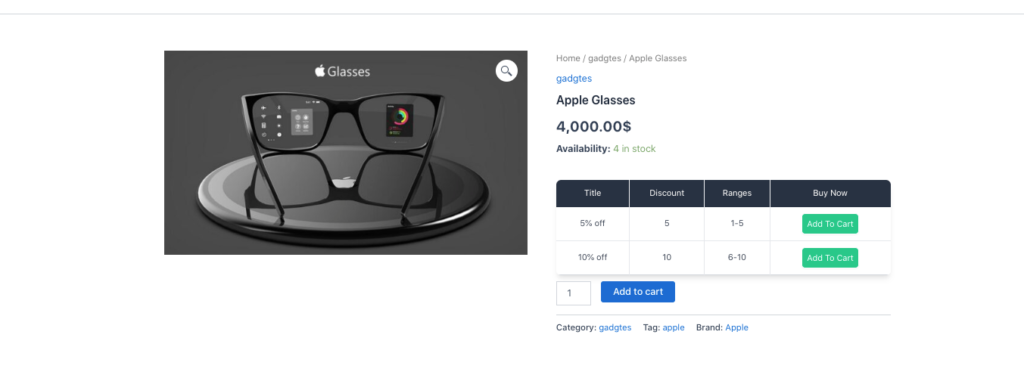
- Add a campaign name (e.g., Buy 1-5 units 5% off, Buy 6-10units 10% off)
- Select the bulk as a discount intent
- Filter products All products/ Few products (your selected products)
- Set a User limit (such as 100), Validity date ( from 19/11/2025 to 21/11/2025)
- Here’s where you define your tiered discount:
Set your desired quantity range from the Minimum Quantity to the Maximum Quantity.
For example – Minimum quantity-1, maximum quantity-5,
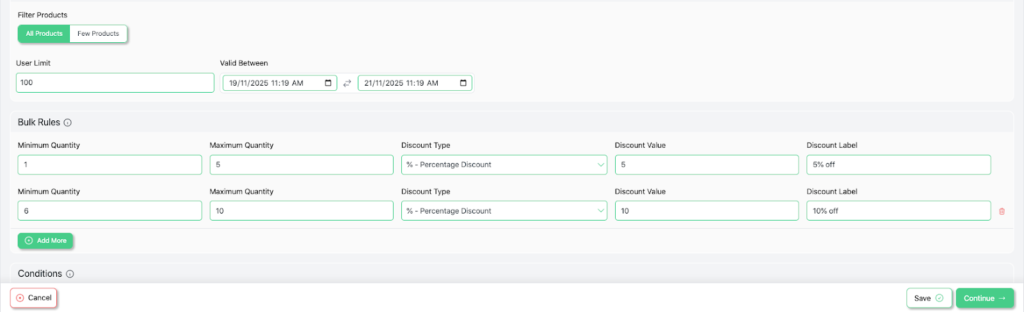
- Add discount type – percentage / fixed/fixed per item, set discount label (e.g., 5% off)
- Click add more to include ranges.
- Save and Exit to activate your campaign.
For a more detailed description, you can also check: How to Set Up WooCommerce Tiered Pricing (Easy Steps).
Creating a volume discount with the Disco plugin
After following all the previous steps, the only alternate step you’ll need to take for a volume discount is this :
- Set Minimum Quantity – 1, Maximum Quantity -5, discount type- percentage discount, discount label – 5% discount
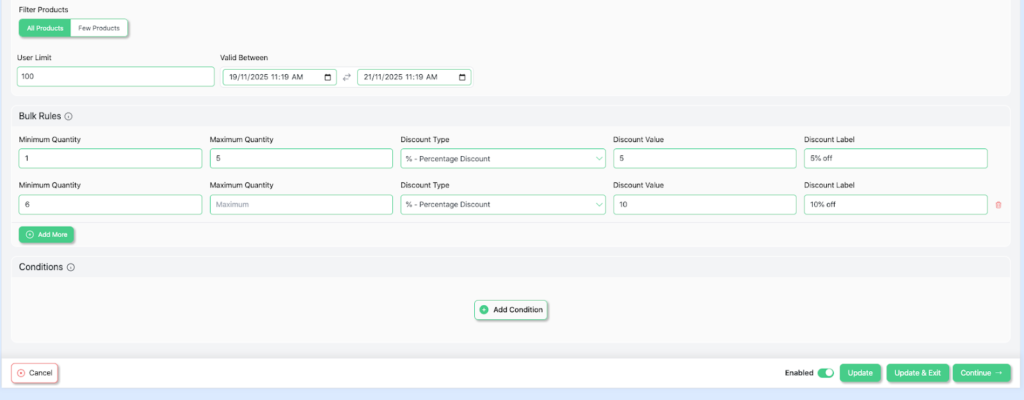
- Add more for adding more ranges. This time, add Minimum Quantity- 6, leave Maximum quantity – blank ( for 6+ any items),
- Discount type: percentage discount, discount label:
- 10% discount.
- Save and exit.
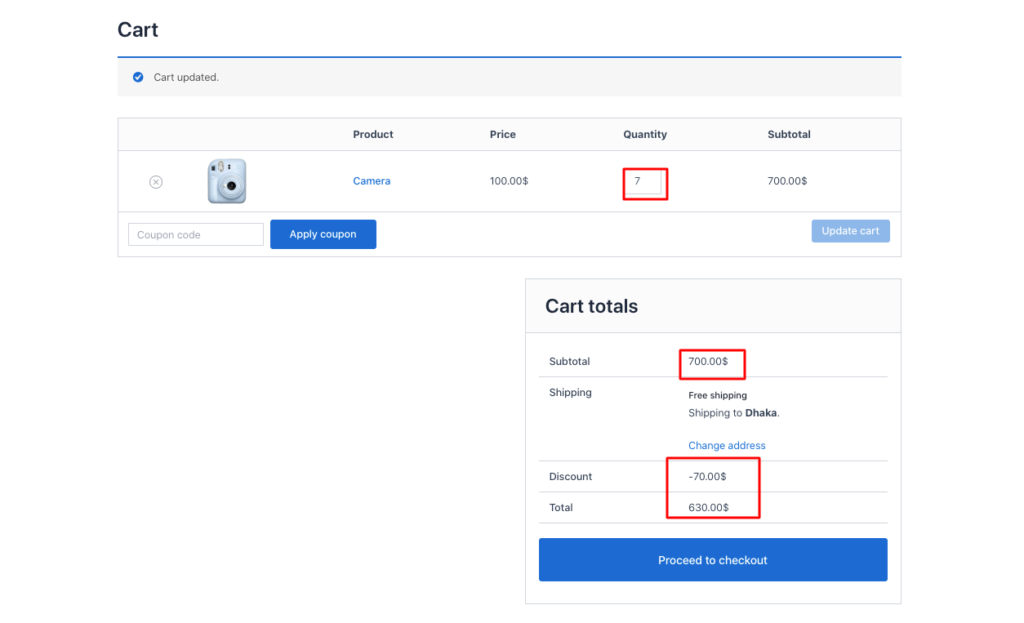
You can also check: How to Set Up Bulk Discounts in WooCommerce
Wrap up:
Lead the pack by choosing the right player for the right task. In other words, make sure your fundamental pricing strategy aligns with your customers’ perceived value.
If you are selling physical goods, a volume discount is a simple yet strategic way to increase your Average Order Value (AOV).
Conversely, if you’re selling software, service, or access, a tiered discount is your clear winner. This mechanism encourages high-value upsells.